Bénédicte Ombredanne–Éric Reinhardt
L'Amour et les ForêtsBénédicte Ombredanne–Éric Reinhardt is a literary friendship formed through letters and deepened by two meetings in Paris. It gives Bénédicte a rare listener to whom she can gradually disclose her life, while its pauses and eventual interruption show how her husband’s control reaches beyond the household and into her communication with others.
Letters and first recognition
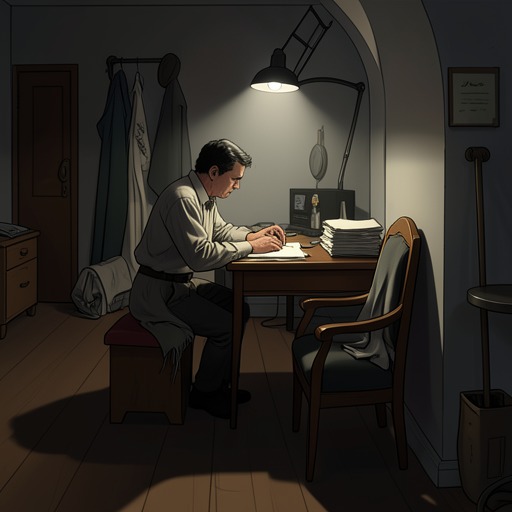
The relationship begins when Éric Reinhardt receives a letter from Bénédicte. She has written because her application to join the readers’ jury for a literary prize was rejected; what disappoints her most is losing the chance to argue for Éric’s novel. Her two-page letter moves from caution toward anger and dissatisfaction, mixing humor, irony, and an impulsive energy. Éric is struck by how well it is written and by the unlikely combination of fervor and wit. He understands its movement as at once timid and audacious, and senses that writing to him may offer Bénédicte an escape from a painful or intolerable situation, though she does not yet explain what that situation is.
Because Bénédicte includes her email address, Éric writes back the following day to thank her. He tells her that the letter has given him pleasure and that he is proud his work has found a reader of her quality. Weeks later she sends a second letter, this time describing what she admired in his novel without the humor of the first. Éric finds it luminous and emotionally intense. He reads the force of her presence not as uncomplicated happiness but as a determination to resist obstacles and, one day, become happy. He also senses that books matter to her with unusual urgency, as if they might rescue her from a life in which she feels trapped. These are Éric’s interpretations of her letters, not knowledge Bénédicte has yet chosen to share directly.
In a later exchange, Bénédicte apologizes for having written at length about her own response to the novel rather than discussing the book in greater detail. Éric replies that the letter is not a burden: it has moved him and, without her intending it, made a revealing self-portrait. He invites her to meet when she next visits Paris. He presents the invitation as an ordinary act of courtesy, rather than a calculated attempt to turn a reader’s admiration into a personal encounter.
Two meetings in Paris
They meet twice at Le Nemours café, near the entrance to the Palais-Royal gardens. Their first meeting takes place in March 2008. Both are nervous, and Éric does most of the talking while Bénédicte asks questions about how he writes his novels. In the weeks afterward, she checks on the progress of his next book and asks whether he has overcome his writing difficulties. Éric, reluctant to discuss his work and unenthusiastic about a sustained correspondence, evades these questions. Their contact consequently fades for a time.
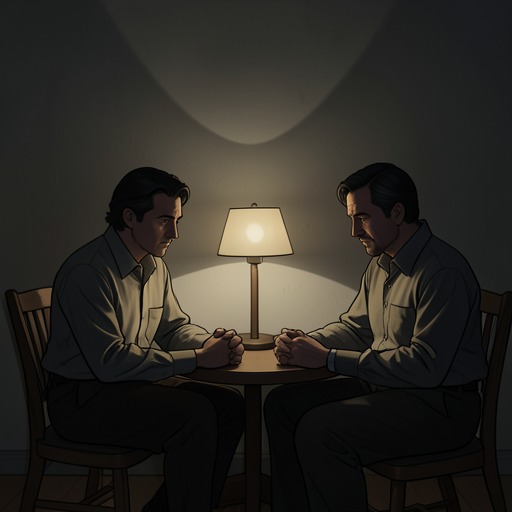
The second meeting comes several months later, on a Sunday in September, when Bénédicte is again in Paris. Éric is initially unwilling to meet again, but avoids giving her a clear refusal. She continues to ask, sending messages each day and writing on the morning of her departure. Her persistence remains considerate, and he agrees to see her early that afternoon. What begins as a meeting he has tried to defer becomes a four-hour conversation. Éric asks questions and encourages her to continue, sensing that she needs to tell someone about her life and that she has kept much of it to herself for years.
The setting sharpens the contrast between appearances and what Bénédicte recounts. They sit on the café terrace in an elegant part of Paris, while she describes experiences that Éric finds deeply troubling. He remembers her telling them with restraint and precision, as though recounting a case at some distance from herself. His response is not simply literary curiosity: he wants to reassure her and believes she must find a way to change a situation that is harming her. Bénédicte agrees in principle that she should act but says she cannot see a way out and sometimes feels close to giving up.
Correspondence as listening and support
After the second meeting, Éric and Bénédicte begin writing again, through text messages and email. The change follows what he has heard at Le Nemours: he wants to know how she is, offer comfort, and ask her to clarify episodes that their conversation only touched upon. Over several months, she sends accounts of what she has lived through in recent years, sometimes attaching pages from her diary or other texts she wrote at the time of the most serious events. Their correspondence thus becomes a record not only of contact between a reader and a novelist but also of Bénédicte’s effort to give shape to experiences that have remained largely unspoken.
The exchange is not uninterrupted. Bénédicte sometimes takes several weeks to answer, even after periods of intense communication. Éric considers whether the silences reflect her own unease as well as her husband’s disapproval. Once the husband learns of the correspondence, he tries to obstruct it. Bénédicte creates a separate email address and checks it only in the staff room at her lycée, a practical measure that reveals how narrow the safe space for communicating with Éric has become. She had hoped they might meet again during a future visit to Paris, but her husband questions why she would return to a retired friend’s home after already visiting in March and September.
Surveillance and the break in contact
Bénédicte’s account of her marriage helps explain why the friendship is difficult to maintain. She tells Christian that her husband does not allow her to have a mobile phone because he fears she might use it to build an independent social life; he has her schedule and expects her to be reachable at home. That account is part of the wider pattern of monitoring in which her contact with Éric is also caught. Éric describes the husband’s repeated calls and questioning as a relentless routine, one that presses Bénédicte to disclose and account for her actions. The relationship with Éric therefore exists under conditions in which ordinary messages and visits can become matters of suspicion.
In March 2009, after several weeks without news from Bénédicte, Éric receives an unexpected call. Speaking quickly and quietly, she asks him not to send text messages and says that their contact must be suspended for a time. She explains that her husband has discovered a second phone hidden behind the collected works of Mallarmé in her office. Messages on it have exposed her communication with another man. To shield that man and prevent her husband from fixating on him, Bénédicte has said that the messages came from Éric. The explanation makes Éric an involuntary part of her attempt to manage a dangerous suspicion, while also placing their own friendship at immediate risk. She has called to warn him, despite the fact that he rarely sends messages, in case he should try to contact her.
Meaning and limits of the relationship
The connection is not presented as a romance between Bénédicte and Éric. Its intimacy comes instead from attention, correspondence, and the gradual disclosure of experiences that she has struggled to share. Éric’s role shifts: first he is the novelist whose work she admires, then a correspondent who recognizes distress in her writing, and finally a listener who tries to help her articulate what happened. His own reluctance—his evasions about his work and hesitation about meeting again—remains part of the history; the closeness does not begin as a simple or effortless mutual commitment.
The letters also preserve a tension between Bénédicte’s self-presentation and Éric’s reading of it. Her early writing is at once playful and angry, controlled and impulsive; he sees in those contrasts a person divided among selves she has had to keep quiet. At the second meeting, her measured narration lets him hear what the polished letters could only suggest. As the correspondence turns into a means of recording her past, the same relationship becomes harder to sustain under surveillance. Its arc is therefore one of growing trust constrained by circumstances: the listener is found, the account is told piece by piece, and then contact itself has to be suspended.